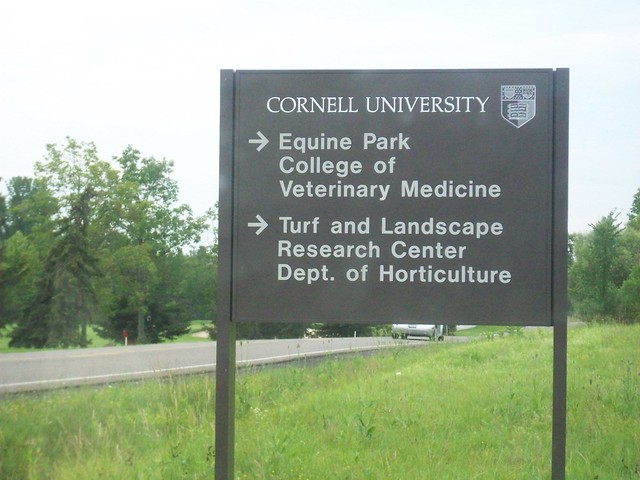
Today we took Sierras All The Gold, our wonderful APHA stallion, to Cornell University's Equine Park to prepare him for his first season of semen collection for non-local mares to be impregnated through artificial insemination (AI). The goal of our visit was twofold:
Sierra needed to learn how to mount the phantom for collection.
We needed to analyze Sierra's sperm to make sure that it is viable for cooling and shipping.
The process can be a difficult learning curve for stallions as it requires them to do something that is completely non-instinctual: mount a phantom. A phantom for breeding is a padded dummy mount that looks quite similar to a gymnastic vaulting apparatus. When you think about it, there is absolutely no reason why a horse would naturally want to jump on top of this, let alone have sex with it!
How the process works is that a mare in heat is selected to be used as a tease, based on the specifications and preferences of the stallion. Yes, stallions have preference; for Sierra his preferences are the little ladies with the giant butts. The mare is then brought out to excite the stallion, causing him to drop his penis so it can be washed. The mare is placed behind a short wall just behind the phantom to encourage the stallion to then mount the phantom. As the stallion mounts, a receptacle is used to gather the semen. The semen is then tested for: presence of urine, sperm count, sperm motility and sperm preference of three extenders that will help keep the sperm viable during the cooling and shipping process.
The mare chosen for Sierra was a cute little buckskin quarter horse, Nina. And she was just perfect for him. He immediately took to her and dropped and was a very good boy about his penis being cleaned. On his first try at the Phantom, Sierra didn't quite understand what we were getting at. The phantom didn't even register. He knew his job: mount the MARE. He ended up mounting the wall and putting his feet over the mare's back instead of mounting the phantom. We were able, however to get a good collection from him, regardless.
Sierra at the Cornell Equine Park with the Phantom
While testing his first collection, we unfortunately found that he had urine in his ejaculate. Urine kills sperm; almost everything kills sperm. This is a common issue. Many stallions, like Sierra, go years successfully impregnating mares through hand breeding and pasture breeding without issues. The mares uterus is amazing at assisting and supporting sperm. However, when breeding through AI it can be a another obstacle in the process.
Example of Equine Sperm Under Microscope (Not Sierra's)
His first collection had a good sperm count of 177 million per milliliter (average sperm concentration is 100-200 million per ml). However, when looking at his first collection of sperm under the microscope, the motility was low (20-30% instead of the average of 70-80%). This was a result of the urine contamination damaging the sperm and reducing motility.
After trying unsuccessfully to get Sierra to urinate before our second attempt, we gave it another go. This time, Sierra figured it out and successfully mounted the phantom. A fantastic learning curve!
In the testing of his second ejaculate, the urine content was greatly diminished. The staff at the Equine Park were also able to sustain the sperm by both centrifuge as well as use of the extender to dilute what urine was in the semen. The results were positive: concentration of 195 million per ml and a 75-80% motility rate. His sperm also seemed to work well in all of the extender options.
Sierras sperm are now undergoing testing to see how well they cool and more information will be available in the future.
So, as a last minute decision I decided to take Little Joe to a hunter/jumper show in Rochester... TOMORROW!
Figured I might actually want to jump him before I arrived in Rochester.
He did a great job and as an afterthought I thought I would post a video of him. I was bummed that we had our leads all worked out until the video camera started, but I guess he was tired after our practice. I was actually shocked he got the wrong lead. He always gets the right one! However... The gate to leave the arena was also to the left.... Hmmm...
(BTW, when he got the proper lead it was a RIGHT lead and I marked it wrongly as a LEFT lead)
So now I am all packed up (and bathed!) and ready to head to Lehman's tomorrow morning with Little Joe.
I'm hoping that people see that I am pushing my boundaries and taking a leap of faith in my horse and our relationship and feel like they can do the same. We all know I'm a horse girl, but not a show girl, but I'm really looking forward to this opportunity.
For me it's a Lehman show.
For others it might be a trail trial, or a local fair!
I want people to get out more with their horses and have little moments of "win" for themselves, their horses and their relationships, even if they don't get a blue ribbon.
Tomorrow is just another trail ride... In an arena... With jumps!
A compilation of reflections and thoughts from years on the trail:
As an owner of a trail riding stable, I have seen many people come through my barn doors. Many are self-admittedly not riders. Others claim to have skills. And some truly impress me - in the good way. I have met some of my best friends on trail, I have seen some truly impressive riders, and I've made some good stories.
One thing I have learned is that the way people describe their skills says more about what we are in for than what they actually are able to do on a horse.
Here is what your classifications via email say to me:
"I am not a rider" This means you ride Pepsi or Dozer. It's going to be a long and slow ride, even on the short trail.
"I'm a recreational rider who can gallop" This means you have gone on a handful of guided rides and the horse started trotting and you thought it was really fast (good or bad).
"I'm a recreational rider and I can trot and canter" At least you know about the multiple speeds of a horse. You probably haven't taken lessons but you have been on a horse enough times to know the difference and you probably won't fall off.
"I used to be able to post a trot, but it's been awhile" Okay, you took lessons. You're probably really rusty and are going to get continually frustrated with your deteriorated skills and lack of riding endurance. You will be severely focused on yourself, but the horse won't care because while you pay attention to your form they can actually do their job, or better yet grab some grass.
"I barrel race" This means that you know how to accelerate but you probably don't know how to steer or stop without torquing on a horse's mouth. You let the horse's need for self-preservation act as breaks and you're going to always be testing your (and my) limits.
"I do dressage" This means that you are going to be under-impressed with my trail horses and they will probably be under-impressed with you too. You're going to expect a higher level of control from my horses throughout the ride that they might be able to do in an arena but isn't realistic on trail. Your constant vying for control might actually tick them off as the horse frames up and collects while continually telling you to "let go and let me do my job" (Unless it is Beau, however. He will like you). Now, if you aren't a dressage rider and think that riding dressage is the same thing as winning a blue ribbon at the county fair in an on the flat walk/trot event (class of 2 riders), well, it will be severely obvious.
"I show jump and take weekly lessons" What this tells me is that you can steer, you can post a trot, and you might actually have good form but that you can't really control a horse. You have probably always taken lessons on a push-button mount with an instructor basically free-lunging as you ride from the center of the arena. I know I do that unconsciously in the lessons I teach and that as soon as I step out of the arena the horses stop appearing to listen to their rider (they were actually listening to me). Out on trail you'll be pulling on the horse's mouth and vying for control that you're not actually capable of. The horse will get riled up and frustrated with your over-confidence.
"I ride western pleasure" You're used to responsiveness and smoothness that you just won't find in many trail horses. That push button horse you have been sitting on is a bit different than our rugged, indestructible trail masters. And while they listen up just fine, it's a 51/49 power relationship on trail and they know how to keep themselves (and you) safe and you're going to have to let them take the lead sometimes. And for heaven sake, please shorten up your reins. You might need to do some direct reining near that corn field.
"I played polo" This is probably the worst thing to tell me if you're not accurate! If you say you've played polo I am going to assume that you are comfortable on a hot horse, used to jigging and dancing, and capable of maintaining fast speeds around sharp turns. My horses will seem boring but they will love you and your fantastic seat and flexible reining. If you lie to me, you will end up on the very wrong horse.
"I do three-day eventing" Okay, a little jumping, a bit of dressage and some cross-country hacking; you've been both in the arena and out of it. You know the difference between a peaceful stroll and arena work. You also know horse's abilities and how to negotiate obstacles. Win for horse, win for me, win for you too (if you're accurate).
What you should actually tell me is more about your personality and what you are looking for from your ride. While it is important to mention whether you have only been on guided trail rides, taken lessons, or ridden independently, your personality makes a big difference in the horse I choose for you. All of my horses are safe but it's like matchmaking for the perfect marriage.
Also, by only telling me about your past I won't know what you want from a trail ride. Giving me a heads up on if you want a simple ride, a couple challenges or a rugged experience will give me a better idea.
A clean stall starts off with lime dust covered with 4-5 bags of pelleted bedding. The lime helps reduce odors and the bedding should provide soft footing and be absorbent for both urine and manure. As a result, bedding should be spread in areas that it is needed the most: the center of the stall, locations where the horse is most likely to urinate and any areas that they tend to pile their manure.
Each stall may be different as horses tend to have different habits. Bedding should not be placed in the following locations as it is wasteful and unnecessary: at the entrance of the stall, under the water bucket, under the hay, and under the feed bucket. This pelleted bedding should last a month. Certain stalls may need one bag added throughout the month, others will not.
Different horses have different habits in stalls. Know your horses, know their habits! Here are some examples of horse "housekeeping" habits:
Differences between the sexes
Mares tend to urinate in the rear of their stall or in one corner
Geldings tend to urinate more near to the center of their stalls
Stallions tend to defecate in large piles, called stallion mounds and urinate more centrally or on their manure piles to mark their territory
Pooping Patterns
Rear Wall Poopers: these horses will only poop along the rear wall of their stall
Corner Poopers: these horses tend to choose a corner of their stall to poop in, and often urinate in the opposite corner
Doorway Poopers: these horses seem to have it backwards and poop in the doorway to their stalls
Bucket Poopers: with deadly aim, these horses almost always seem to poop in their water buckets or feed buckets, wherever they may lie
Everywhere: the worst are the horses that just don't seem to care where they poop
Stall behavior that affects stall clean-outs
Rototillers: These horses are pacers, they tend to walk in a circular pattern. The result of their movement tends to cover the manure and spread it to the edges of the stall. It is important to sift underneath the bedding in all corners of the stall to find the buried poop and the hidden urine areas.
Lazy Horses: some horses lay down on their manure packing it into the stall making it more compact and harder to clean
Hold-it-in Urinating: many horses, especially in the winter, hold in their urine until they get to their stall. As a result their urine spot becomes large and needs even more bedding for absorbing the urine. If this urine spot isn't cleaned to the bottom regularly the urinated bedding will begin to mound.
Breeding Season: mares especially urinate more during breeding season
Slobs: some horses will keep it clean if it starts clean, but if it's already messy they turn into true slobs - similar to humans in our bedrooms!
Daily Cleaning of Stalls:
Start at the doorway and sift through the bedding using the basket pitchfork, collecting all manure and dirtied hay.
Where bedding is wet, just toss the bedding without sifting
Any potential area where the horse has urinated, take the metal pitchfork and dig into the bedding to loosen it and remove any compressed or wet bedding - this may be the entire rear area of the stall
Scrape all bedding away from the walls of the stall, the doorway or any feeding areas and mound it in the center
Full Cleaning of Stalls:
You'll notice as the month goes on that the bedding is appearing "used" and it is losing its absorbent qualities and the amount of bedding is reducing. Coach it through the last week of use with very thorough daily cleanings but do not add any bedding because the stall will need a full clean out shortly. Some horses may need a full clean out monthly, others may be very tidy and need a full clean out less often.
Use the metal pitch fork first to dig into the stall removing as much bedding as possible. You will notice that the bedding may be removed in layers - cleaning a stall may seem like an archaeological dig. Remove all layers until you reach the base of the stall.
Scrape the remaining bedding off of the ground using the large muck shovels. At this point there should be no bedding, dirty or clean, left on the surface of the stall. All manure should be removed.
Spread lime on the entire base of the stall, especially where horses tend to urinate or defecate.
Replace bedding with 4-5 bags of new bedding, centered in the stall.
MEDICAL CARE and DISEASES Vet Farrier Dentistry Annual vaccines and tests Limping - how to tell Thrush Abscess Hives Rain Rot Tying Up Colic
GROOMING Curry Comb Shedding Brush Hard Brush Soft Brush Face Brush Mane and Tail Brush Picking Hooves
WORKING AROUND HORSES How to halter a horse Lead a horse How to tie a horse
TACK Saddle parts Bridle parts Types of bits and hackamores How to put on the saddle Saddle Fit How to put on the bridle How to adjust stirrups How to put on Bell Boots How to put on Sport medicine boots How to put on polo wraps
STABLE MANAGEMENT Clean a stall dump manure Types of bedding Hang buckets and give water Give horse feed How to open hay bales Working in order - don't miss a stall Tools: - Metal pitch fork - Plastic basket pitch fork "sifter" - Wheel barrow - Spigot and Hose - Feed Buckets - Water Buckets - c hooks - Hay Hooks
HORSE NUTRITION Protein, Fat, Fiber, carbohydrates Feed types Hay types Supplements and Salt licks