Showing posts with label Cornell University. Show all posts

Wednesday, December 23, 2015

Equine Apprentice Internship

 Painted Bar Stables is proud to offer our apprentice internship program. This Program is fast paced and filled with educational opportunities only gained by working in the industry. 


A leader in the trail riding industry in the Finger Lakes Region, Painted Bar Stables is a 125 acre ranch and stable located on Seneca Lake in the beautiful Finger Lakes Wine Country. We maintain roughly 30 head of well trained and versatile trail and lesson horses along with mares, babies and our stallion.

Internships will be catered to the interest and future goals of each intern. Focuses could include: Equine Schooling and Training, Instruction and Lesson Planning, Tourism Industry and Client Care, Public Relations and Marketing, Breeding and Young Stock Handling, Veterinary Care, etc...

As an intern you will have the opportunity to work in the training, breeding and general management divisions of the farm. Every day duties will include feeding, checking horses, saddling and warming up horses for training, grooming, guiding trail rides, teaching novice lessons, helping to head Girl Scout and 4-H camp programs, and maintaining a clean professional working environment. 

Depending on the ride schedule and time of year, interns will be involved with trail rides, clinics, hunter paces, overnight guiding, horse sales prep, foal handling, routine medical care such as worming, vaccinations, farrier and dentist scheduling. If the opportunity aligns with breeding season, Interns will be able to foal out a mare and participate in the care of the mare and foal after parturition. They will also be able to assist with the breeding activities of our stallion such as live cover breeding on the farm as well as semen collection at Cornell University. Additionally, interns will see office and client management, record keeping and marketing practices as well as become familiar with required legal and insurance logistics associated with owning and operating a stable or ranch. And above all else, Interns will be able to further develop their own riding and training skills while riding available horses at the ranch.


Typical Seasonal Jobs

  • September - November
    Foliage and wine tourists, boost in our lesson program, organizing for winter
  • December - February
    Schooling and training of horses, incoming training clients, winter maintenance, winter trail rides as requested, lessons focused on bareback riding and technical riding .
  • March - May
    Reboot of our lesson program, usually a spring horse show, steady increase in trail riders, breeding of our stallion.
  • June - AugustSummer Camps, tourism trail rides, youth programs

Because Summer (July - August) is our busiest season as well as the highest demand for internships, we usually do specific interviewing for internships at that time in March. All other seasons have lower demand for internships because most students are at university. 

Compensation: 
This is a full time commitment. We provide shared furnished housing on the farm in our intern apartment and a weekly allowance of $100. 

Requirements: 


  • Individuals must be quick and proactive learners, energetic, optimistic, reliable and professional. 
  • Capable of interacting with clients and the public on a regular basis, extroverts preferred 
  • Must be 18 years or older. 
  • Must be able to lift an 80# bag of grain unassisted.
  • Must have a valid drivers license and we suggest having a vehicle of your own
  • Must have a cell phone with text and email capability.
  • Computer skills required


Preferred Skills and Abilities include: experience in tourism businesses, public speaking, marketing and public relations, driving manual transmission automobiles, operating tractors, advanced computer skills, and experience designing and implementing projects. 

Minimum Commitment: 4 Weeks 


Riders of all skill levels accepted as riding skills can be taught and improved; however, assigned duties with the horses will vary based on proficiency with horses. Preference is for accomplished riders as a main benefit of the internship is the opportunity for unlimited schooling. 

We do not allow personal horses to accompany interns as past experiences have proven them to be a distraction from the learning benefits of working with a multitude of different horses within our stables.

For More information about our program please contact me by email paintedbarstables@gmail.com or visit our website, www.paintedbarstables.com. 

If you would like to apply, send a resume, references and a short video of you riding and/or pictures by email. You can also follow us on our Painted Bar Stables facebook page.

Thursday, September 13, 2012

Bad News Bear


Fracture in Left Hind Splint bone

Gator, then Zorba, is now officially named "Bad News Bear"

I had a strange feeling last night about Bear and decided to squeeze him in at Cornell for an ultrasound of his hind left today when we brought Cola for a farrier appointment.

On Saturday (5 days earlier) Bear had come in from his evening in the back field with a very swollen fetlock. It was so tender that he broke away from the wall. We buted him immediately hoping it was a sprained fetlock.

As the days passed, I wrapped him, iced him, cold hosed him and the swelling went down a bit in the fetlock. However he still had a little "overall" swelling and was definitely still lame. We tried stall rest in a 12'x12' stall but he was so anxious we decided to put him out at night.

Today during the ultrasound none of his tendons or ligaments had issues; so we probed deeper. As we were watching we uncovered a hidden puncture wound - very small wound. As we probed we saw what appeared to be a fracture in the splint bone. The fracture isn't even close to where he was swollen.

See a clip from the ultrasound: http://youtu.be/UUs5Nyht8CM

Radiographs confirmed that he had indeed fractured his splint bone.


He is now on antibiotics and bute hoping to avoid any infection in the bone and avoid surgery. He has on a sweat wrap, which will come off tomorrow and be replaced with a pressure wrap. He will be on stall rest 24/7. Because he gets so anxious in a stall, we have him on the broodmare indoor-outdoor stall so he can have a little more space.

Frustration cannot begin to explain where I am at right now. Bear is a horse I just purchased merely 3 weeks ago for jumping lessons. He's a wonderful guy and I was eager to play with him and take him to the fall hunter paces. I went to Cornell to confirm that it was just a simple sprain and could have him on regulated turnout and I came back with something surprising.

He is officially a wonderful Bad News Bear.

Wednesday, March 28, 2012

Sierras All The Gold learns to mount the Phantom

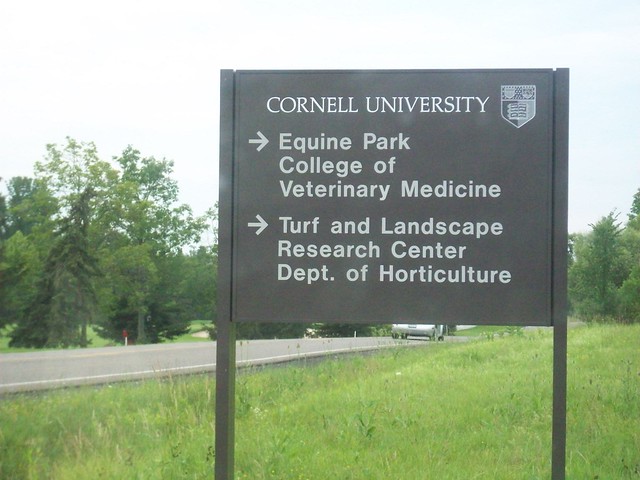
Today we took Sierras All The Gold, our wonderful APHA stallion, to Cornell University's Equine Park to prepare him for his first season of semen collection for non-local mares to be impregnated through artificial insemination (AI). The goal of our visit was twofold:
  1. Sierra needed to learn how to mount the phantom for collection.
  2. We needed to analyze Sierra's sperm to make sure that it is viable for cooling and shipping.
The process can be a difficult learning curve for stallions as it requires them to do something that is completely non-instinctual: mount a phantom. A phantom for breeding is a padded dummy mount that looks quite similar to a gymnastic vaulting apparatus. When you think about it, there is absolutely no reason why a horse would naturally want to jump on top of this, let alone have sex with it!

How the process works is that a mare in heat is selected to be used as a tease, based on the specifications and preferences of the stallion. Yes, stallions have preference; for Sierra his preferences are the little ladies with the giant butts. The mare is then brought out to excite the stallion, causing him to drop his penis so it can be washed. The mare is placed behind a short wall just behind the phantom to encourage the stallion to then mount the phantom. As the stallion mounts, a receptacle is used to gather the semen. The semen is then tested for: presence of urine, sperm count, sperm motility and sperm preference of three extenders that will help keep the sperm viable during the cooling and shipping process.

The mare chosen for Sierra was a cute little buckskin quarter horse, Nina. And she was just perfect for him. He immediately took to her and dropped and was a very good boy about his penis being cleaned. On his first try at the Phantom, Sierra didn't quite understand what we were getting at. The phantom didn't even register. He knew his job: mount the MARE. He ended up mounting the wall and putting his feet over the mare's back instead of mounting the phantom. We were able, however to get a good collection from him, regardless. 

Sierra at the Cornell Equine Park with the Phantom


While testing his first collection, we unfortunately found that he had urine in his ejaculate. Urine kills sperm; almost everything kills sperm. This is a common issue. Many stallions, like Sierra, go years successfully impregnating mares through hand breeding and pasture breeding without issues. The mares uterus is amazing at assisting and supporting sperm. However, when breeding through AI it can be a another obstacle in the process.

Example of Equine Sperm Under Microscope (Not Sierra's)

His first collection had a good sperm count of 177 million per milliliter (average sperm concentration is 100-200 million per ml). However, when looking at his first collection of sperm under the microscope, the motility was low (20-30% instead of the average of 70-80%). This was a result of the urine contamination damaging the sperm and reducing motility.

After trying unsuccessfully to get Sierra to urinate before our second attempt, we gave it another go. This time, Sierra figured it out and successfully mounted the phantom. A fantastic learning curve!


In the testing of his second ejaculate, the urine content was greatly diminished. The staff at the Equine Park were also able to sustain the sperm by both centrifuge as well as use of the extender to dilute what urine was in the semen. The results were positive: concentration of 195 million per ml and a 75-80% motility rate. His sperm also seemed to work well in all of the extender options.

Sierras sperm are now undergoing testing to see how well they cool and more information will be available in the future.

Monday, September 26, 2011

Sierra and Little Joe take a trip to Cornell

So today's agenda had nothing to do with the betterment of our horse's training and everything to do with the improved understanding of our horses. Little Joe and Sierra have both had their various issues so today was the day to take them to Dr. Fortier at the Cornell University Equine Hospital.
Little Joe and Sierras All The Gold awaiting tests at Cornell Equine Hospital

Little Joe and his Fibrotic Myopathy
About two months ago, I noticed a change in Little Joe's gait and a hard buildup in his left hindquarters. In an instant I knew what it was ossifying myosis or a fibrotic myopathy. I had seen this before in one of my previous horses, Bubba, and Joe had all of the classic diagnostic symptoms:

  • His walk was very slow, however his trot and canter were unaffected.
  • His gait at the walk was changed. His left hind was no longer reaching forward as far and had an accentuated outward swing. As the landed it first had an upward lift with a heavy plop down.
  • The tight ball in his hind quarters followed the groove of his semitendinousus muscle and felt like a rock inside his body.
Little Joe receiving his ultrasound
Today at Cornell, Dr. Fortier instantly agreed with me, however reassured me that he was displaying very minor conditions. The ultrasound proved that there was in fact a mineral build up in the muscle that extended roughly 15cm down along his semitendinousus and was roughly 4cm thick and 2.5cm wide. Luckily the build up was centralized in his muscle and did not cross into his semimembranosus.
This is a view of Little Joe's semitendinosis. You can see the white line (which was measured to be 4.46cm). That is the mineral deposit in the center of his muscle. The shadow below indicates that this not the muscle fascia and is instead the hardened area as the shadow is created because the ultrasound cannot pass through the mineral deposits.
How did this most likely happen: fibrotic myosis is especially common in Quarter Horses and other stock breeds such as Paints. It is unknown if it is because of their muscle structure or the work that they typically do, however. Often this occurs after a injury such as a kick to the hindquarters. Considering Little Joe has very active pasture manners and is turned out with an even more active companion (Fire) they probably got in a tiff and Little Joe received a swift kick to his butt that did not heal properly and began building up mineral deposits.

What does this mean: Fibrotic myopathy is rarely progressive and this is a mild presentation causing only mechanical lameness that is not affecting Little Joe's athetic ability. The muscle will continue to exist as is does. It will not improve and it will not degrade. Little Joe will always have a shortened stride but he does not feel any pain. He can be ridden to whatever his capability may be and will continue to enjoy it. His walk will continue to feel a little uneven but he is not unsound or lame - just stiff. His trot will remain even and his canter, he will slightly favor his right lead. I was encouraged to ride him.
The only option for fibrotic myosis is surgery to remove the mineralized buildup in the muscle. There's no guarantee that it will improve his ability, and there's also a chance it could cause more issues. Because he is so minimally impacted by the issue, there is no reason for surgery.


Sierras and the Fractured Navicular
When I bought Sierras All The Gold, I purchased my dream horse. He was a 6½ year old stallion who was peaceful, intelligent, beautiful, nice conformation, and moreover, a pleasure to ride. His trot was the epitome of a Western Jog. He rode in mixed company and was always a gentleman.

About 1½ months after I bought him, I noticed something was off. He had a limp that would come and go. I was too busy to ride often so it didn't really affect our riding schedule, but it bothered me on many levels. The first vet I brought in thought it might be a result of the thrush that I had been battling since I had purchased him. The next vet thought it might be navicular syndrome, a degenerative tendon disease. The third vet xrayed him and we found a clean fracture in his left navicular bone dividing the bone in two on the far left side of the bone (the outer wing).

In many ways I was relieved: I am very glad that it is not navicular syndrome. Since Sierra is a stud, a disease such as this would have ruined his career. Though navicular disease is not a genetically inherited disease, predisposition for it can be inherited (such as cancer or eyesight issues in humans). I could stand never riding him, but never breeding him would have been an added blow. Unfortunately, at the time, I was short on money and short on ideas. I brought him to the Cornell farrier, at the time Mike Wildenstein, and we did a series of glue-on shoes but I felt that it didn't make enough improvement so I backed off and just continued with usual farrier care.

This summer Branden Van Loon was kind enough to bring those old radiographs to Dr. Fortier at Cornell for a peek. Based on those radiographs, she felt it would be possible to do a partial neurectomy (not full!) and reduce his pain and even make it possible to use him for regular light riding. I was encouraged! I spent all summer saving money to try to help him out and get him on the road to the most productive life possible.

After nerve blocks today it was indicated that blocking the nerves via neurectomy would eliminate his pain. However, we learned today is that his navicular bone has degraded significantly since those initial x-rays. Perhaps is was that the initial x-rays were films taken on my dirt floor barn without sedating Sierra compared to the minimally sedated digital x-rays in Cornell's immaculate facility that made us see all of the actual problems. Or perhaps his bone had really and truly just degraded. Either way, at this point the gap between the bone segments had increased and the larger portion of the bone had worn away significantly along the fracture line and there was weakening to the internal bone structure.
Sierras All The Gold receiving his nerve block shots peacefully
What does this mean: Sierra is now not able to safely receive a neurectomy. The degradation of the bone has created a roughness along the bottom. This is the surface that the digital flexor tendon crosses as it connects to the hoof. As long as Sierra is aware of pain, he will know when there is too much friction between the bone and the tendon. If we did the neurectomy he would not feel this pain and there is a chance that that friction could sever the tendon. A severed digital flexor tendon is an end of life injury. Additionally, because the structure of the bone is compromised we could no longer do a partial neurectomy and have it eliminate his pain.

What can we do: Before the doctors could even get to it, I had Steve Krauss, the current Cornell Farrier, summoned to Sierra's side. The doctors and Steve decided that through bute and corrective shoeing we could make improvements to Sierra's life that could even make him capable of rare riding experiences.
Steve also noted that Sierra's hoof was not currently proportioned correctly. The distance between his heel to frog tip was shorter than the distance from frog tip to toe (this is backwards of what it is supposed to be). So he shortened up Sierra's toe and filed the toe at a 45-degree angle to increase roll-over. He also installed a pair of inverse aluminum shoes with heel supports with a silicone putty pad on the heel and frog for additional support.

Here we go! Let's see if it helps!

Summary
While Joe had good news and Sierra is still going to give me many hard decisions, all I can say is both of the boys showed off our stable amazingly. Their peaceful and calm demeanor was heavily respected and rewarded. Joe was used as a student walk-through demo. One of the Farrier students even gave me an offer on Sierra. It was lovely to have such well-behaved boys who took each test with grace.

At the end of the day, they both jumped right up on the trailer, excited to go home again.

Sunday, March 27, 2011

Tickled Pink!

I have a student here who is taking the semester long riding course at Cornell for credit. She has learned a lot there but feels like she needs more riding time to really succeed at that course. She needs help with her balance and coordination at the trot and she's absolutely right - more riding time will get her where she wants to be!

The other day after her lesson she said "Your horses aren't like the horses at Oxley. They go where I tell them to go."

Needless to say, I was tickled pink. For a number of reasons.
  1. I grew up at the Oxley Equestrian Center, working as a youth and teenage stable hand, riding their horses, taking their lessons. Amazingly enough, the horse that she rides there is one of the horses I actually learned to canter on. I have a lot of respect for those horses and the workload that they take and the fact that they still behave so well. I also know that they are all worked very regularly to ensure that they keep up to date on their training. 
  2. I STILL ride at the Oxley Equestrian Center every Monday night because sometimes, I just need a break from riding here in the cold and need to go to a real jumping facility to hone my skills. I love having a bunch of people there ready and willing to offer advice, consult, and even rip my own riding to shreds because I just can't get that at home. Plus, I have always found the horses there willing and excellent for jumping and most of my horses here are still green at jumping courses.  
  3. My horses are good lesson horses, but I always saw them as trail horses first: no spook, no flee, no qualms, sturdy, rugged and willing to do and go anywhere. 
It never occured to me that the work I was doing with them has actually changed them into not only good lesson horses, but phenomenal ones. They all move off of the leg, they can collect or extend when asked, they all can frame up, they can move laterally, they can bend (some better than others), and they can pick up the canter on cue almost every time (most can even pick up the canter on the proper lead in my very small indoor arena). For a group of lesson horses, that either came to me green broke or as true-blue trail horses, I am impressed.

Yes, they don't always act like push-button rides, especially if the rider is sending mixed messages or is off in la-la-landl; but what they do offer is the perfect platform to teach on. For instance:
  • If your heels aren't down Maxie most definitely will not trot in the arena. 
  • If you are too hard on the reins, Pepsi will start to make her lip-smacking noise. 
  • If Scotch even thinks that you're about to fall off she will stop and look at you. 
Add to that the fact that a majority of my lesson horses are mares. That's unheard of, I know. But these girls are so good. They listen so well, and even though they can make some ugly faces once in awhile, they always behave themselves under saddle. 

This whole thought tickles me pink.