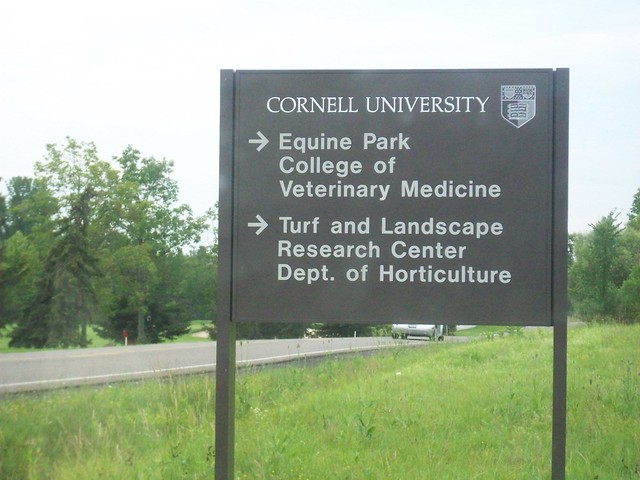
So today's agenda had nothing to do with the betterment of our horse's training and everything to do with the improved understanding of our horses. Little Joe and Sierra have both had their various issues so today was the day to take them to Dr. Fortier at the Cornell University Equine Hospital.
 |
| Little Joe and Sierras All The Gold awaiting tests at Cornell Equine Hospital |
Little Joe and his Fibrotic Myopathy
About two months ago, I noticed a change in Little Joe's gait and a hard buildup in his left hindquarters. In an instant I knew what it was ossifying myosis or a fibrotic myopathy. I had seen this before in one of my previous horses, Bubba, and Joe had all of the classic diagnostic symptoms:
- His walk was very slow, however his trot and canter were unaffected.
- His gait at the walk was changed. His left hind was no longer reaching forward as far and had an accentuated outward swing. As the landed it first had an upward lift with a heavy plop down.
- The tight ball in his hind quarters followed the groove of his semitendinousus muscle and felt like a rock inside his body.
 |
| Little Joe receiving his ultrasound |
Today at Cornell, Dr. Fortier instantly agreed with me, however reassured me that he was displaying very minor conditions. The ultrasound proved that there was in fact a mineral build up in the muscle that extended roughly 15cm down along his semitendinousus and was roughly 4cm thick and 2.5cm wide. Luckily the build up was centralized in his muscle and did not cross into his semimembranosus.
 |
| This is a view of Little Joe's semitendinosis. You can see the white line (which was measured to be 4.46cm). That is the mineral deposit in the center of his muscle. The shadow below indicates that this not the muscle fascia and is instead the hardened area as the shadow is created because the ultrasound cannot pass through the mineral deposits. |
How did this most likely happen: fibrotic myosis is especially common in Quarter Horses and other stock breeds such as Paints. It is unknown if it is because of their muscle structure or the work that they typically do, however. Often this occurs after a injury such as a kick to the hindquarters. Considering Little Joe has very active pasture manners and is turned out with an even more active companion (Fire) they probably got in a tiff and Little Joe received a swift kick to his butt that did not heal properly and began building up mineral deposits.
What does this mean: Fibrotic myopathy is rarely progressive and this is a mild presentation causing only mechanical lameness that is not affecting Little Joe's athetic ability. The muscle will continue to exist as is does. It will not improve and it will not degrade. Little Joe will always have a shortened stride but he does not feel any pain. He can be ridden to whatever his capability may be and will continue to enjoy it. His walk will continue to feel a little uneven but he is not unsound or lame - just stiff. His trot will remain even and his canter, he will slightly favor his right lead. I was encouraged to ride him.
The only option for fibrotic myosis is surgery to remove the mineralized buildup in the muscle. There's no guarantee that it will improve his ability, and there's also a chance it could cause more issues. Because he is so minimally impacted by the issue, there is no reason for surgery.
Sierras and the Fractured Navicular
When I bought Sierras All The Gold, I purchased my dream horse. He was a 6½ year old stallion who was peaceful, intelligent, beautiful, nice conformation, and moreover, a pleasure to ride. His trot was the epitome of a Western Jog. He rode in mixed company and was always a gentleman.
About 1½ months after I bought him, I noticed something was off. He had a limp that would come and go. I was too busy to ride often so it didn't really affect our riding schedule, but it bothered me on many levels. The first vet I brought in thought it might be a result of the thrush that I had been battling since I had purchased him. The next vet thought it might be navicular syndrome, a degenerative tendon disease. The third vet xrayed him and we found a clean fracture in his left navicular bone dividing the bone in two on the far left side of the bone (the outer wing).
In many ways I was relieved: I am very glad that it is not navicular syndrome. Since Sierra is a stud, a disease such as this would have ruined his career. Though navicular disease is not a genetically inherited disease, predisposition for it can be inherited (such as cancer or eyesight issues in humans). I could stand never riding him, but never breeding him would have been an added blow. Unfortunately, at the time, I was short on money and short on ideas. I brought him to the Cornell farrier, at the time Mike Wildenstein, and we did a series of glue-on shoes but I felt that it didn't make enough improvement so I backed off and just continued with usual farrier care.
This summer Branden Van Loon was kind enough to bring those old radiographs to Dr. Fortier at Cornell for a peek. Based on those radiographs, she felt it would be possible to do a partial neurectomy (not full!) and reduce his pain and even make it possible to use him for regular light riding. I was encouraged! I spent all summer saving money to try to help him out and get him on the road to the most productive life possible.
After nerve blocks today it was indicated that blocking the nerves via neurectomy
would eliminate his pain. However, we learned today is that his navicular bone has degraded significantly since those initial x-rays. Perhaps is was that the initial x-rays were films taken on my dirt floor barn without sedating Sierra compared to the minimally sedated digital x-rays in Cornell's immaculate facility that made us see all of the actual problems. Or perhaps his bone had really and truly just degraded. Either way, at this point the gap between the bone segments had increased and the larger portion of the bone had worn away significantly along the fracture line and there was weakening to the internal bone structure.
 |
| Sierras All The Gold receiving his nerve block shots peacefully |
What does this mean: Sierra is now not able to safely receive a neurectomy. The degradation of the bone has created a roughness along the bottom. This is the surface that the digital flexor tendon crosses as it connects to the hoof. As long as Sierra is aware of pain, he will know when there is too much friction between the bone and the tendon. If we did the neurectomy he would not feel this pain and there is a chance that that friction could sever the tendon. A severed digital flexor tendon is an end of life injury. Additionally, because the structure of the bone is compromised we could no longer do a partial neurectomy and have it eliminate his pain.
What can we do: Before the doctors could even get to it, I had Steve Krauss, the current Cornell Farrier, summoned to Sierra's side. The doctors and Steve decided that through bute and corrective shoeing we could make improvements to Sierra's life that could even make him capable of rare riding experiences.
Steve also noted that Sierra's hoof was not currently proportioned correctly. The distance between his heel to frog tip was shorter than the distance from frog tip to toe (this is backwards of what it is supposed to be). So he shortened up Sierra's toe and filed the toe at a 45-degree angle to increase roll-over. He also installed a pair of inverse aluminum shoes with heel supports with a silicone putty pad on the heel and frog for additional support.
Here we go! Let's see if it helps!
Summary
While Joe had good news and Sierra is still going to give me many hard decisions, all I can say is both of the boys showed off our stable amazingly. Their peaceful and calm demeanor was heavily respected and rewarded. Joe was used as a student walk-through demo. One of the Farrier students even gave me an offer on Sierra. It was lovely to have such well-behaved boys who took each test with grace.
At the end of the day, they both jumped right up on the trailer, excited to go home again.